
Fontenoy



Implementing Discipline
The original French War Plan (Plan XVII) of 1914 required their soldiers to throw themselves at the Germans in all out attack. In their red and blue uniforms they presented easy targets to the German machine gunners. Apart from the horrendous casualties incurred, this style of attack resulted in some units realising that they were being asked to achieve the impossible - morale started to fall.
An indication of French casualties can be gained from the following statistics.
- 1 384 000 French soldiers were killed during the entire length of the war.
- 454 000 of these were killed during the months of August to November 1914.
In October 1914 General Villaret issued orders that the troops must be dealt with in a strong and disciplined manner. His orders resulted in numerous Courts Martial and often for trivial offences.
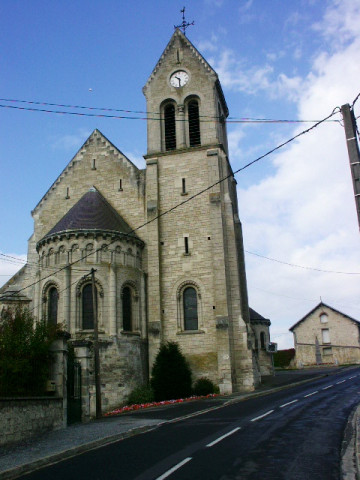
Fontenoy
This is a small village about 10 kilometres to the west of Soissons along the main N 31 towards Compiègne.
Just after the French Military Cemetery at Ambleny turn right onto the D 17.

Within a kilometre you will reach a bridge over the river Aisne. It was the only one available for troops heading up to the front line near Confrécourt and it soon became infamous for its casualty rate. The cemetery you have just passed contains many of those who were killed here.
At Port Fontenoy turn right following the D 91 into Fontenoy village (Note that in French, names that end in -oy are pronounced -wah and not -oi.)
Within the village there is a small monument to two soldiers who were shot by firing squad. Make your way to the village and then walk down the side of the church (there is a sign) towards the playing fields.
About 200 metres down the lane you will come to a small obelisk proclaiming the story of these two men. It was inaugurated by the local Maire M Gerbault in 1994 who explained the reason why it was necessary for a memorial. It was there to remind people of injustice, of an injustice that had resulted in the deaths of soldiers.
This small monument is thought to have been the first erected in honour of French soldiers passés par les armes (Shot at dawn)

Léonard Leymarie
Léonard Leymarie was born on the 4th January 1880 and thus by the time of the war was old enough to be required to serve in a reserve regiment. As such he was assigned to his local unit: the 305è RI (Infantry Regiment). Each Active Regiment had a reserve recognisable by the addition of 200 to the number - 105th and 305th.
Whilst acting as a forward observer in the trenches he was hit in the hand by an enemy round. His comrades told him to go back and get himself treated.
His quitting his post resulted in his Court Martial for abandoning his post as a result of self mutilation. The prosecution was based on a dubious medical report and Leymarie protested his innocence throughout. Very little of the circumstances came out at his trial and he was convicted and shot that same afternoon at 1630 hours at Port Fontenoy.
Leymarie left behind a wife and two young children who were taken into the care of the State in 1919.
He was rehabilitated in 1923 but there is no mention on his card as to exactly when. He is buried at Ambleny (Grave: B 135) and was granted the title of Mort pour la France. He has however not been added to his town War Memorial at Seilhac. According to the Minister for Veteran's Affairs, it is up to the community to decide who goes on or does not. There is no compulsion.
Lucien Bersot
Lucien Bersot was born on the 7th June 1881 at Authoison (Haute-Saône). Having completed his military service (As all Frenchmen did on attaining 20 years of age) he found himself called up into the 60è RI an active front line unit (Reservists in time of war were also used to bolster the numbers in the parent unit).
The regiment found itself in action near Soissons and despite heavy losses was not considered to have been very pro-active as we would say these days.
As his own uniform had become ripped Bersot asked his sergeant for a new issue. The Sergeant said that none were available but that he should use those of his friend who had been killed in front of him and were still covered in blood. When he refused to put them on he was charged and initially given 8 days for disobeying an order. His commanding officer Lt Colonel Auroux would appear to have been looking to set an example and not only charged Bersot but also presided over his Court Martial (Completely contrary to regulations).
When two friends tried to speak up on his behalf they were sentenced to hard labour - in North Africa.
To no great surprise Auroux found the soldier guilty of disobedience in the face of the enemy and condemned him to death. He was shot the following day: 13th February 1915.
Following the war his case was taken up by one of the Associations and a Court of Appeal on 12th July 1922 could do little apart from find him innocent. Rehabilitated he was like Leymarie accorded the important status of : Mort pour la France. Without it no pension would have been paid to their widows and of course families of the shot had to suffer the social stigma and no small amount of shunning by the community.
Many of the families had to struggle against the establishment for years in trying to get justice for their loved ones. In Bersot's case the argument was even put forward that they were not trying to apportion blame, just that the injustice should be recognised.
His body was repatriated to Besançon with great ceremony by the organisations fighting on behalf of the executed.
In France the campaign for those Shot at Dawn was based on individual cases whereas in the UK a blanket pardon was the objective.
The Victims of Vingré
For an insight into the most controversial of all these cases as well as the fierce fighting in this area return towards Pont Fontenoy but turn right towards Nouvron along the D 17 and then to the nearby village of Vingré via the D 2020.
 Nouvron and the Broken Cross
Vingré and the trial of a unit
Mutiny on the Chemin des Dames
French National Cemetery at Ambleny
Nouvron and the Broken Cross
Vingré and the trial of a unit
Mutiny on the Chemin des Dames
French National Cemetery at Ambleny