
Les Villages Detruits



The Destroyed Villages of Verdun
In and around the Verdun Battlefield are the missing villages. Places that were so heavily bombarded that they were annihilated.
Village |
Lost |
Retaken |
Croix de Guerre |
Beaumont |
23 02 16 |
08 10 18 |
15 03 21 |
Béthincourt |
08 04 16 |
26 09 18 |
15 03 21 |
Bezonvaux |
25 02 16 |
16 12 16 |
15 03 21 |
Cumières |
24 05 16 |
20 08 17 |
09 09 20 |
Douaumont |
06 03 16 |
24 10 16 |
09 09 20 |
Fleury |
23 06 16 |
18 08 16 |
09 09 20 |
Forges |
06 03 16 |
26 09 18 |
05 12 21 |
Gremilly |
1914 |
11 11 18 |
05 12 21 |
Haucourt |
31 03 16 |
26 09 18 |
---- |
Haumont |
22 02 16 |
08 10 18 |
24 03 24 |
Louvremont |
24 02 16 |
15 12 16 |
09 09 20 |
Ornes |
24 02 16 |
23 08 17 |
08 03 21 |
Vaux |
31 03 16 |
03 11 16 |
09 09 20 |
Within weeks of the opening of hostilities the village of Gremilly to the north-east of Verdun found itself occupied by the German army of the Crown Prince.
For the other villages, in what became known as the Red Zone the next two years would be a time of waiting.
Initially a quiet enough area the villages were used as refuges and for billeting.
21 February 1916

The massive bombardment which opened the battle for Verdun spelt the destruction of all the villages. Gremilly, safe behind the German front line was to suffer at the hands of the French artillery.
Most devastated and fought over were the three villages of Douaumont, Fleury and Vaux. Between 23 June and 18 August Fleury, at the centre of the battlefield was taken and retaken 16 times.
The term destroyed makes you think of Ieper, its Cloth Hall lying in ruins, or London during the Blitz. For these villages though, the constant battering of artillery, some of it the heaviest and most concentrated of the entire war, meant that the buildings were reduced to rubble, which was further ground down.
Soon only the cellars existed and as the weeks wore on even their outlines began to disappear in the midst of the cratered landscape.
For some of the villages the transition did not rest there. Fleury has gone, aerial photos at the time could find no trace of it at all, and now a simple stone memorial announces: Ici fut Fleury - Here Was Fleury.
Everywhere that you walk on the Verdun battlefield there are craters. Amongst the trees at Fleury (which due to its position is the most visited of these villages) the old streets and houses have been marked by placards explaining what was where.

Fields of Carnage
Unlike in other areas of France where the villagers returned and rebuilt their homes on the exact spots of the ruins, it was not possible to go back to these villages.
The ground had lost its top soil and replaced it with the bodies of hundreds of thousands of dead, rotting equipment and rusting weapons.
Shells continue to rise to the surface and for this reason the government of the time decided to buy up the land: 19,571 hectares of it, almost the entire area over which the two sides fought for ten months.
In 1928 re-forestation began and over the intervening decades nature has found a way to reassert itself.
Walking around the battlefield the shell holes are easily seen through the trees. Whereas on the Somme or at Ieper where indications of the destruction are few and far between, the entire Verdun battlefield is cratered.
A note about visiting
I am not sure whether or not it has to do with this sacredness of the ground, or just lack of interest, but you will not find a place to get food or drink on the battlefield. There is the café next to the Ossuary at Douaumont, but that would appear to be about it.
I felt certain as we went out onto the battlefield on a very hot day that the Memorial Museum had a café - but it doesn't. Picnic areas seem to be confined to the outskirts of the forests.
As always with the battlefields, if you find something that looks like old armaments - do not touch them.
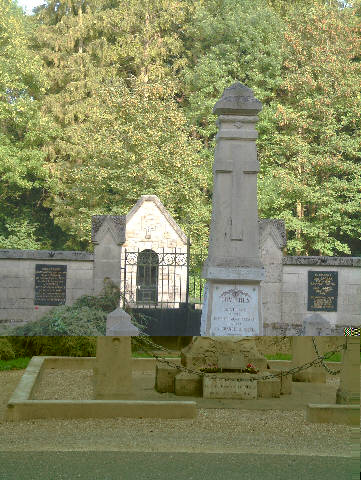
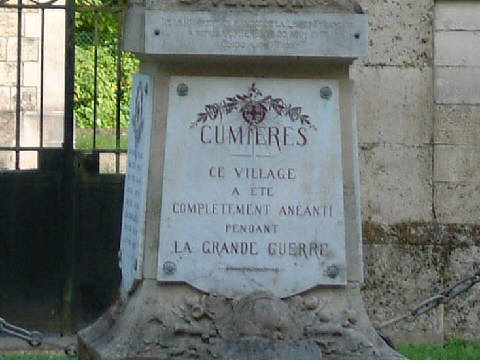
Cumières: This village was completely annhiliated during the Great War