
Verdun



Fort Froideterre
When visiting the battlefield sites of Verdun it is perhaps too easy to look at the major forts with their mangled turrets and battered hulks and forget that the greater part of the battle was fought by men in trenches trying to wrench or recover these concrete monoliths from the other side.
Once Douaumont and Vaux had fallen the battle turned towards the smaller forts guarding the final crests between the Germans and Verdun. One of these was the small Ouvrage of Froideterre. These Ouvrages were meant to fill the gaps between forts, more as part of the greater defensive network than as the last line of resistance.
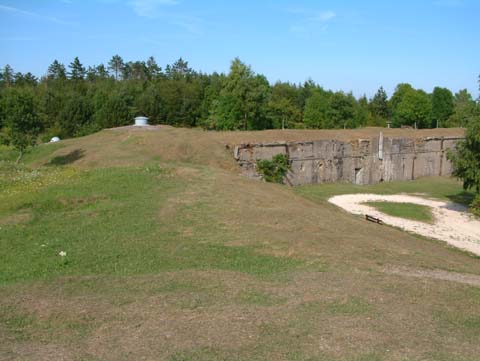
Froideterre could hold about 200 troops in relative safety in a barracks on your right as you enter the car park.
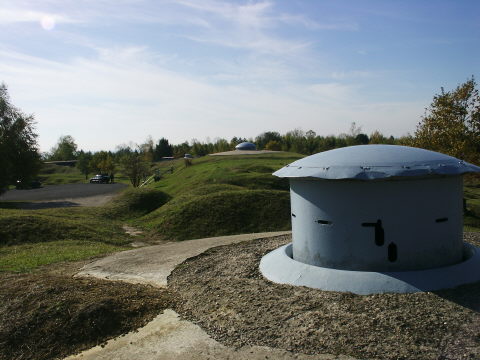
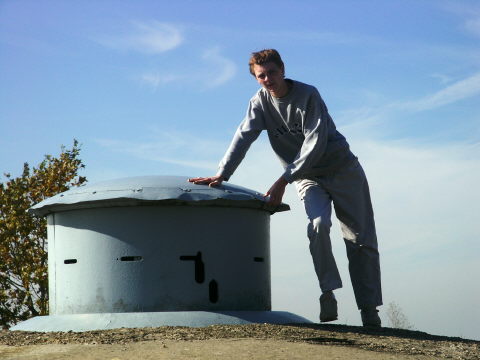
It had two machine gun turrets, plus a 75mm turret facing eastwards towards Thiaumont and a 75mm Bourg Casemate facing westwards towards the Ouvrage at Charny.
The two observation turrets provided excellent views over the local countryside and were to prove a key factor in the defence of the fort.
As part of the German Army's final push towards Verdun Froideterre was subjected to an artillery preparation including gas shells on the night of 22nd June 1916. The following morning troops of the 10th Bavarian Infantry Regiment gained the court of the fort and started throwing hand grenades through breaches in the wall, one grenade caused a fire in one of the munitions chamber causing a lot of smoke.
The fort's machine guns came into action forcing the Germans to ground in the shell holes their own artillery had created or into the fort's ditch, whilst the 75mm turret swept the surrounding area with close range shrapnel.
By late-morning the 150 defenders had repulsed all attempts to gain entry and towards noon a counter attack led by soldiers of the 106e BCP and 297e RI cleared the structure of the remaining assailants.

Despite continuous bombardment for two days the turrets remained functional and were able eventually to beat the Germans back.
You can enter the fort but you will need a torch. Be aware of the dangers of going inside and read the notices.
Quatre Cheminées
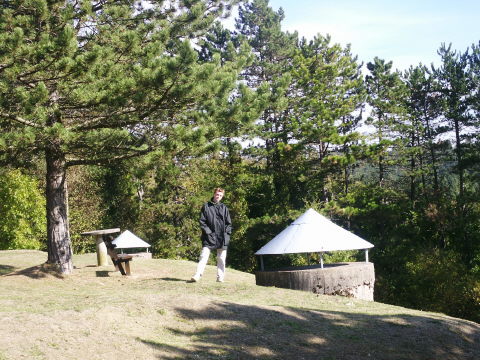
The Quatre Cheminées was in fact a barracks and Brigade Headquarters built 10 metres underground. The routes to the rear lead directly down into the Ravine des Vignes and the village of Bras.
During the night stretcher bearers and American ambulance volunteers would evacuate the wounded away from the dressing stations down towards the relative safety of Bras.
During their attack on 23 June 1916 Bavarian infantry managed to reach the roof and entrances of the shelter. For four days they dropped grenades down the chimneys which served as ventilation shafts. They were eventually beaten off by a counter-attack by the 114th Battalion of Alpine Chasseurs, supported by the 75mm turret gun from Froideterre a short distance away.
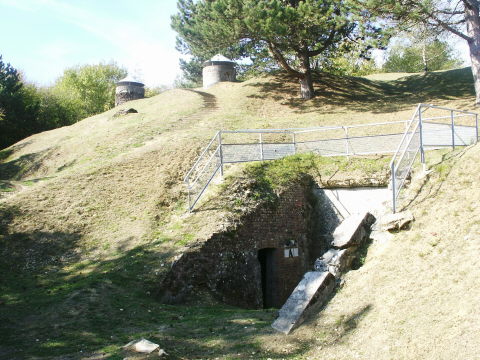
On the far slope you will find the two entrances to the shelter and if you take a look inside you will find that you are entering simple galleries about 70 metres in length.
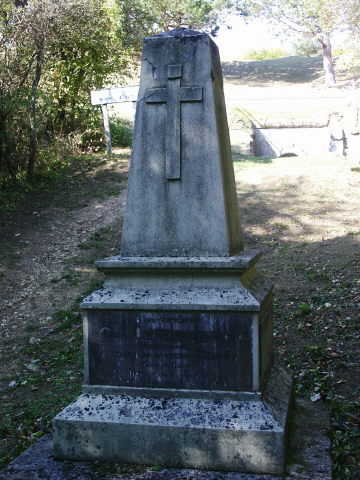
Almost into the trees near the entrances is this memorial to Captain Pierre Cazalls de Fondouce of the 1st Hussars, who was killed at Froideterre on 8 August 1916.