

Rocquigny-Equancourt Rd British Cemetery
Location
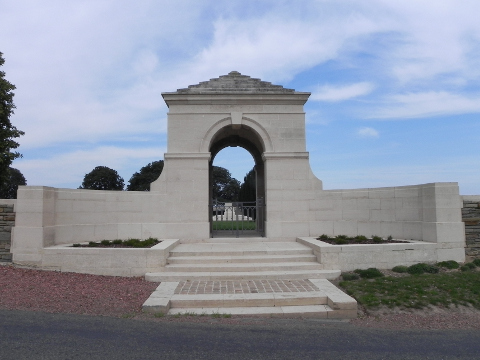
Rocquigny and Equancourt are two villages in the Department of the Somme, some 13 kilometres north of Péronne and 12 kilometres south-east of Bapaume. Rocquigny and Equancourt are approximately 8 kilometres apart and the Rocquigny-Equancourt British Cemetery lies about halfway between the two villages on the north side of the road just west of the crossing road from Etricourt to Ytres.
| GPS | N | E | OSM |
|---|---|---|---|
| Decimal | 50.044187 | 2.989612 | Map |
Historical Information
Etricourt was occupied by Commonwealth troops at the beginning of April 1917 during the German withdrawal to the Hindenburg Line. It was lost on the 23rd March 1918 when the Germans advanced, but regained at the beginning of September.
The cemetery was begun in 1917 and used until March 1918, mainly by the 21st and 48th Casualty Clearing Stations posted at Ytres, and to a small extent by the Germans, who knew it as “Etricourt Old English Cemetery”.
Burials were resumed by Commonwealth troops in September 1918 and the 3rd Canadian and 18th Casualty Clearing Stations buried in it in October and November 1918.
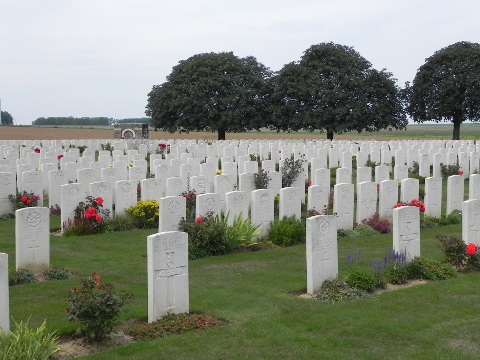
The cemetery contains 1,838 Commonwealth burials and commemorations of the First World War. 21 of the burials are unidentified and nine Commonwealth graves made by the Germans which cannot now be found are represented by special memorials. The cemetery also contains 198 German war burials and the graves of ten French civilians.
The cemetery was designed by Sir Reginald Blomfield.
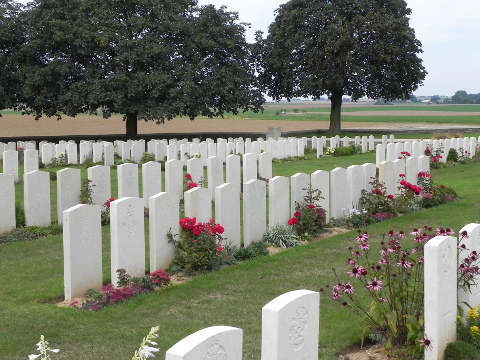
Some of the German graves
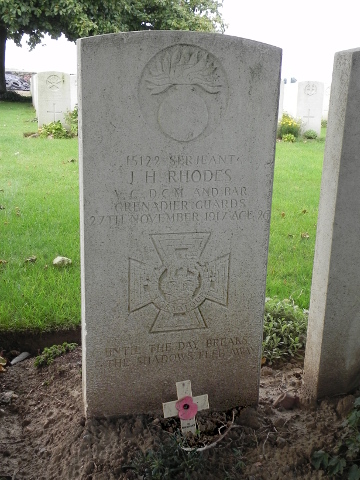
15122 Sergeant John Rhodes VC DCM & Bar
3rd Bn Grenadier Guards
Died on 27th November 1917 aged 26
Husband of Lizzie Rhodes
of 27, New St., Pittshill, Stoke-on-Trent
Grave: III E 1
The London Gazette 30400
23rd November 1917
For most conspicuous bravery when in charge of a Lewis gun section covering the consolidation of the right front company. He accounted for several enemy with his rifle as well as by Lewis gun fire, and, upon seeing three enemy leave he went out single handed through our own barrage and hostile machine-gun fire, and effected an entry into the “pill-box.” He there captured nine enemy including a forward observation officer connected by telephone with his battery. These prisoners he brought back with him, together with valuable information.
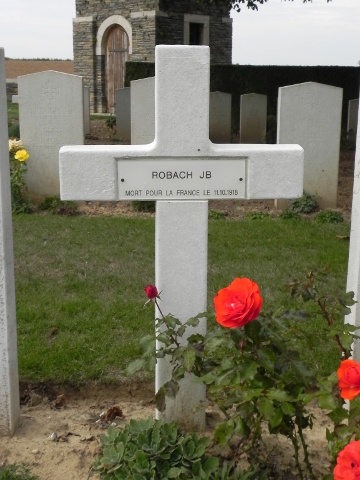
J B Robach
Died on 11th October 1918
One of the French civilians
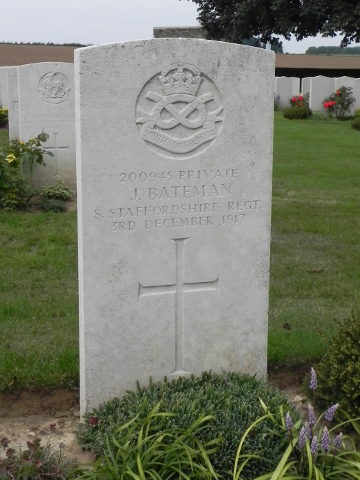
Private Joseph Bateman 200945
2nd Bn South Staffordshire Regiment
Died on 3rd December 1917
Husband of Florence Bateman
of 7a, Vauxhall Street, Dudley
Grave: VI A 27
Shot at Dawn for desertion
In October 1917 Bateman went absent only to be arrested the following day. He managed to escape from custody but was re-arrested in Boulogne six days later. He had been quite clear on his initial arrest that he had deserted and his subsequent attempt to flee merely proved the point.