


Birr Cross Roads Cemetery
Location
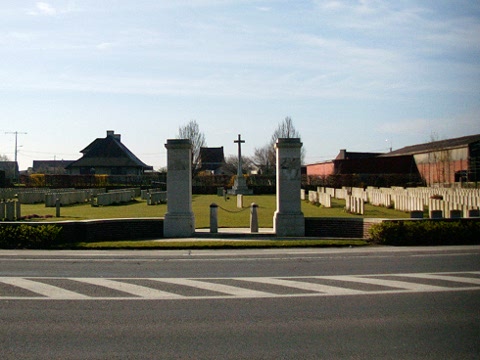
Birr Cross Roads Cemetery is located 3 km east of Ieper town centre, on the Meenseweg (N8), connecting Ieper to Menen. From Ieper town centre the Meenseweg is located via Torhoutstraat and right onto Basculestraat. Basculestraat ends at a main crossroads, directly over which begins the Meenseweg. The cemetery itself is located 2.5 km along the Meenseweg on the right hand side of the road.
| GPS | N | E | OSM |
|---|---|---|---|
| Decimal | 50.84754 | 2.92870 | Map |
Historical Information
The village and the greater part of the commune of Zillebeke were within the Allied lines until taken by the Germans at the end of April 1918. The village was recovered by the II Corps on 8th September 1918. Birr Cross Roads was named by the 1st Leinsters from their depot.
The cemetery was begun in August 1917 and used by dressing stations. At the Armistice, it contained nine irregular rows of graves, now part of Plot I, but was greatly enlarged when graves were brought in from the surrounding battlefields and from certain smaller cemeteries.
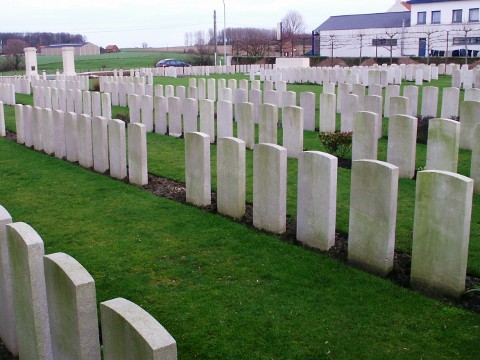
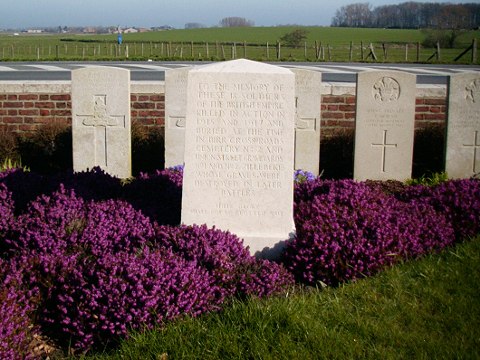
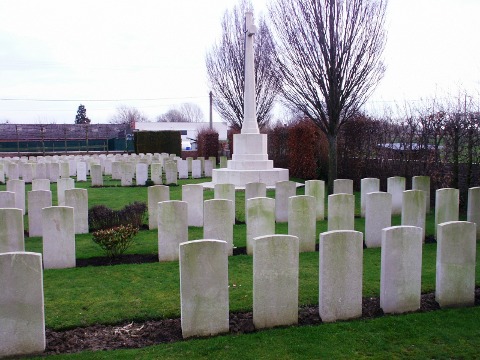
There are now 833 Commonwealth servicemen of the First World War buried or commemorated in this cemetery. 336 of the burials are unidentified but there are special memorials to nine casualties known or believed to be buried among them.
Other special memorials commemorate 18 casualties buried in Birr Cross Roads Cemetery No 2 and the Union Street Graveyards, whose graves were destroyed by shell fire, and a Belgian Interpreter whose grave cannot now be found.
The cemetery was designed by Sir Edwin Lutyens.
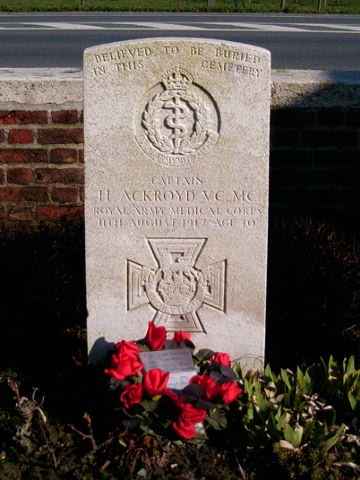
Captain Harold Ackroyd VC MC
Royal Army Medical Corps
6th Bn Royal Berkshire Regiment
Died on 11th August 1917 aged 40
Son of Edward Ackroyd, of Southport
Husband of Mabel Ackroyd,
of Link Lodge, Malvern Link
Special Memorial 7
The London Gazette
4th September 1917
For most conspicuous bravery. During recent operations Capt. Ackroyd displayed the greatest gallantry and devotion to duty. Utterly regardless of danger, he worked continuously for many hours up and down and in front of the line tending the wounded and saving the lives of officers and men.
In so doing he had to move across the open under heavy machine-gun, rifle and shell fire. He carried a wounded officer to a place of safety under very heavy fire.
On another occasion he went some way in front of our advanced line and brought in a wounded man under continuous sniping and machine-gun fire.
His heroism was the means of saving many lives, and provided a magnificent example of courage, cheerfulness, and determination to the fighting men in whose midst he was carrying out his splendid work. This gallant officer has since been killed in action.
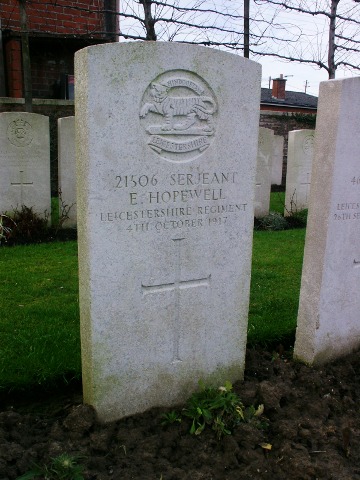
Sergeant E Hopewell 21506
11th Bn Leicestershire Regiment
Died on 4th October 1917
Grave: III C 9
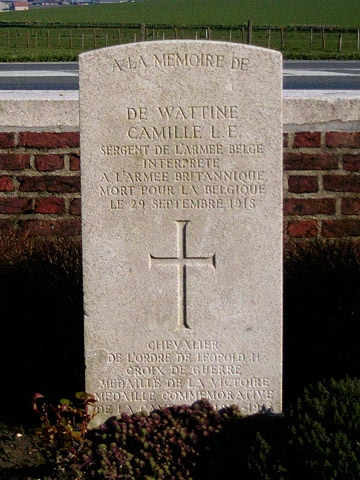
Sergent Camille de Wattine
L’armée belge
Interpreter with the British Army
Died on 29th September 1918
Chevalier de l’Ordre de Léopold II
Croix de Guerre
Special Memorial