


Feuchy Chapel British Cemetery
Location
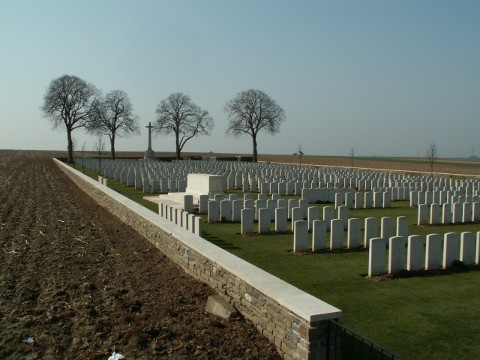
Wancourt is a village in the Department of the Pas-de-Calais. It lies in the valley of the Cojeul River nearly 2 kilometres south of the main road from Arras to Cambrai. Feuchy Chapel British Cemetery is situated on the south side of this road.
Note that this is a very busy road. If you are coming from the direction of the autoroute/Cambrai, it is illegal to cross over the central reservation.
There are roundabouts either side of the cemetery so use these and the parking area next to the cemetery.
| GPS | N | E | OSM |
|---|---|---|---|
| Decimal | 50.269271 | 2.856467 | Map |
Historical Information
Wancourt was captured on 12th April 1917 after very heavy fighting, lost in March 1918, and retaken by the Canadian Corps on the following 26th August. The cemetery was begun by the VI Corps Burial Officer in May 1917, used at intervals until March 1918, and again in August and September 1918. At the Armistice, it contained 249 graves, all in the present Plot I.
It was then enlarged when 834 graves (mainly of April and May 1917) were brought in from the battlefields of Fampoux, Roeux, Monchy and Wancourt, and from a few smaller burial grounds, including :
- Feuchy Chapel Quarry Cemetery, Feuchy, about 200 metres North of Feuchy Chapel, containing the graves of 17 soldiers from the United Kingdom who fell in April 1917.
- Guildford Trench Cemetery, Tilloy-les-Mofflaines, between Blangy and Tilloy, containing the graves of 24 soldiers from the United Kingdom (mainly of the 12th Division) who fell on the 9th April 1917.
There are now 1,103 Commonwealth burials and commemorations of the First World War in this cemetery. 578 of the burials are unidentified but there are special memorials to 14 casualties known or believed to be buried among them.

Other special memorials commemorate six casualties buried in Feuchy Chapel Quarry Cemetery, whose graves were destroyed by shell fire.
The cemetery was designed by Sir Edwin Lutyens.
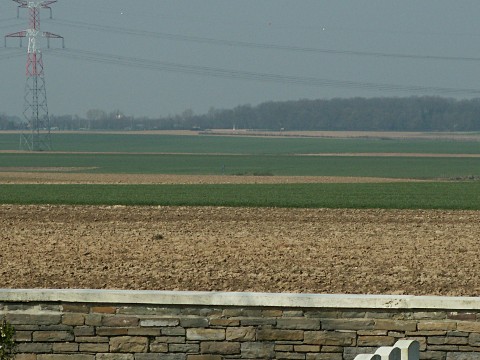
Looking west towards the wood at Tilloy les Mofflaines
Just in front is the white cross of the village’s CWGC Cemetery
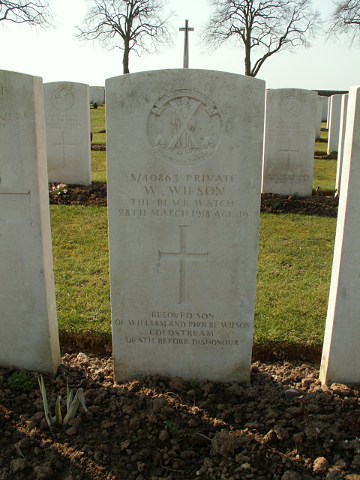
Private William Wilson S/40863
9th Bn The Black Watch
Royal Highlanders
Died on 28th March 1918 aged 19
Son of William and Phoebe Wilson
of 2 Abbey Rd, Coldstream, Berwickshire
Grave: III F 3
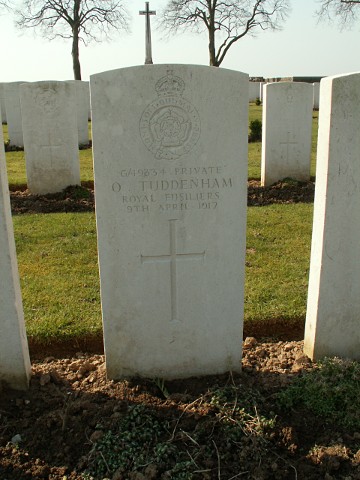
Private Oswald Tuddenham G/44
9th Bn Royal Fusiliers
Died on 9th April 1917
Grave: II H 17
12th (Eastern) Division Memorial

The Divisional cross commemorating 1917

The Vauthier borne commemorating 1918
A short distance further along the road towards the autoroute (that is towards Cambrai) there is a memorial cross dedicated to the men of the 12th Division who fought here in April 1917.
Almost opposite is one of the Touring Club de France marker stones (Created by the Parisian sculptor Paul Moreau-Vauthier) commemorating the position where the German advance of Spring 1918 was halted.