


Brown's Copse Cemetery
Location
Roeux is a village about 8 kilometres east of Arras. Brown’s Copse Cemetery is about one kilometre north-west of Roeux on the eastern outskirts of the neighbouring village of Fampoux. It is signposted from Fampoux village.
From Arras the easiest route is perhaps to come out to Monchy le Preux on the D939 following the direction of the battle in 1917. Turn to the left into the village visiting the monuments if you so wish before continuing along the D33 to Roeux.
In the centre of Roeux turn left again in the direction of Fampoux. You will pass two other CWGC Cemeteries along the way (Both are a little difficult to access). Just after crossing the TGV line you will see Brown’s Copse cemetery.
| GPS | N | E | OSM |
|---|---|---|---|
| Decimal | 50.302869 | 2.883804 | Map |
Historical Information
Roeux was built over a system of caves which helped to make its capture in 1917 exceptionally difficult. It was attacked by the 9th (Scottish) Division without success on 12th April. The chemical works close to the railway station were taken by the 51st (Highland) Division on 22nd April and after incessant fighting, the village was cleared by the same Division on 14th May.
The chemical works were lost again and retaken on 16th May. The Germans re-entered the village at the end of March 1918, and it was finally retaken by the 51st Division on the following 26 August.
The infamous chemical works were on the site of the current Carrefour
supermarket next to the railway crossing.
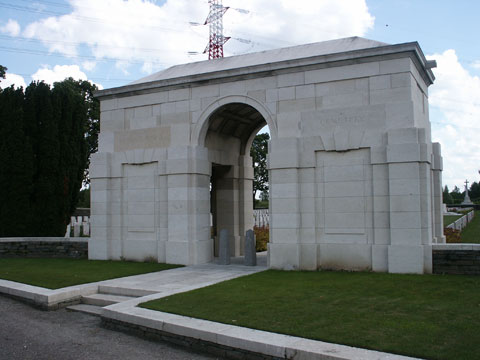
The cemetery is named from a small copse (the Bois Rossignol) on the east side. Plots I to IV are composed almost entirely of graves cleared from the battlefield in the summer of 1917.
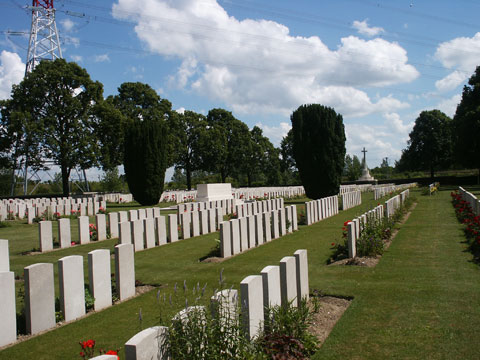
Plots V to VIII were made after the Armistice when 850 graves were brought in from a wide area north and east of Arras. The following were the only considerable burial grounds from which British graves were taken to Brown’s Copse Cemetery :
- Seaforth Cemetery, Roeux, North-East side of the road from the village to the station, where 18 soldiers from the United Kingdom were buried in April 1917, and 21 of the 6th Seaforths in August and September 1918.
- Vitry-en-Artois Communal Cemetery and German Extension, in which 17 soldiers from the United Kingdom (mainly officers of the Royal Flying Corps) were buried by the enemy.
The cemetery now contains 2,072 burials and commemorations of the First World War. 862 of the burials are unidentified but there are special memorials to eight casualties known or believed to be buried among them. Other special memorials commemorate two casualties buried in Vitry-en-Artois Communal Cemetery German Extension, whose graves could not be found.
The cemetery was designed by Sir Edwin Lutyens.


Lieutenant Donald Mackintosh VC
3rd Bn Seaforth Highlanders
Died on 11th April 1917 aged 21
Son of Col Donald Mackintosh
CB MVO MB LLD
and Margaret Mackintosh
of Western Infirmary House, Glasgow
Educated Fettes College
Joined Seaforth Highlanders in 1914
Grave: II C 49
The London Gazette
8th June 1917
For most conspicuous bravery and resolution in the face of intense machine gun fire. During the initial advance he was shot through the right leg, but though crippled he continued to lead his men and captured the trench.
In the captured trench Lieutenant Mackintosh collected men of another company who had lost their leader, and drove back a counter-attack. He was again wounded, and although unable to stand, he continued, nevertheless, to control the situation.
With only fifteen men left, he ordered his party to be ready to advance to the final objective, and with great difficulty got out of the trench and encouraged his men to advance. He was again wounded and fell.
The gallantry and devotion to duty of this officer were beyond all praise.
The memorial to the Seaforth Highlanders is just to the north of Fampoux alongside Sunken Road Cemetery.
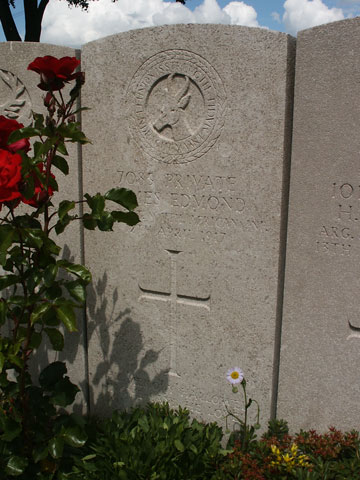
Private James Edmonds 7085
2nd Regiment South African Infantry
Died on 12th April 1917 aged 26
Son of John and Margaret Edmond
of Belfast, Ireland
Husband of Mary Edmond
of East Worldham, Hampshire, England.
Served with South African Irish Horse
in German South West Africa 1914
and the Boer Rebellion
Grave: II E 15
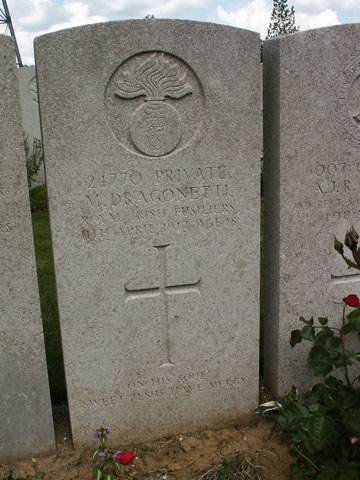
Private Michael Dragonetti 24770
1st Bn Royal Irish Fusiliers
Died on 11th April 1917 aged 18
Son of Pasquale Dragonetti
of 70 Great Patrick St, Belfast
Grave: III F 34